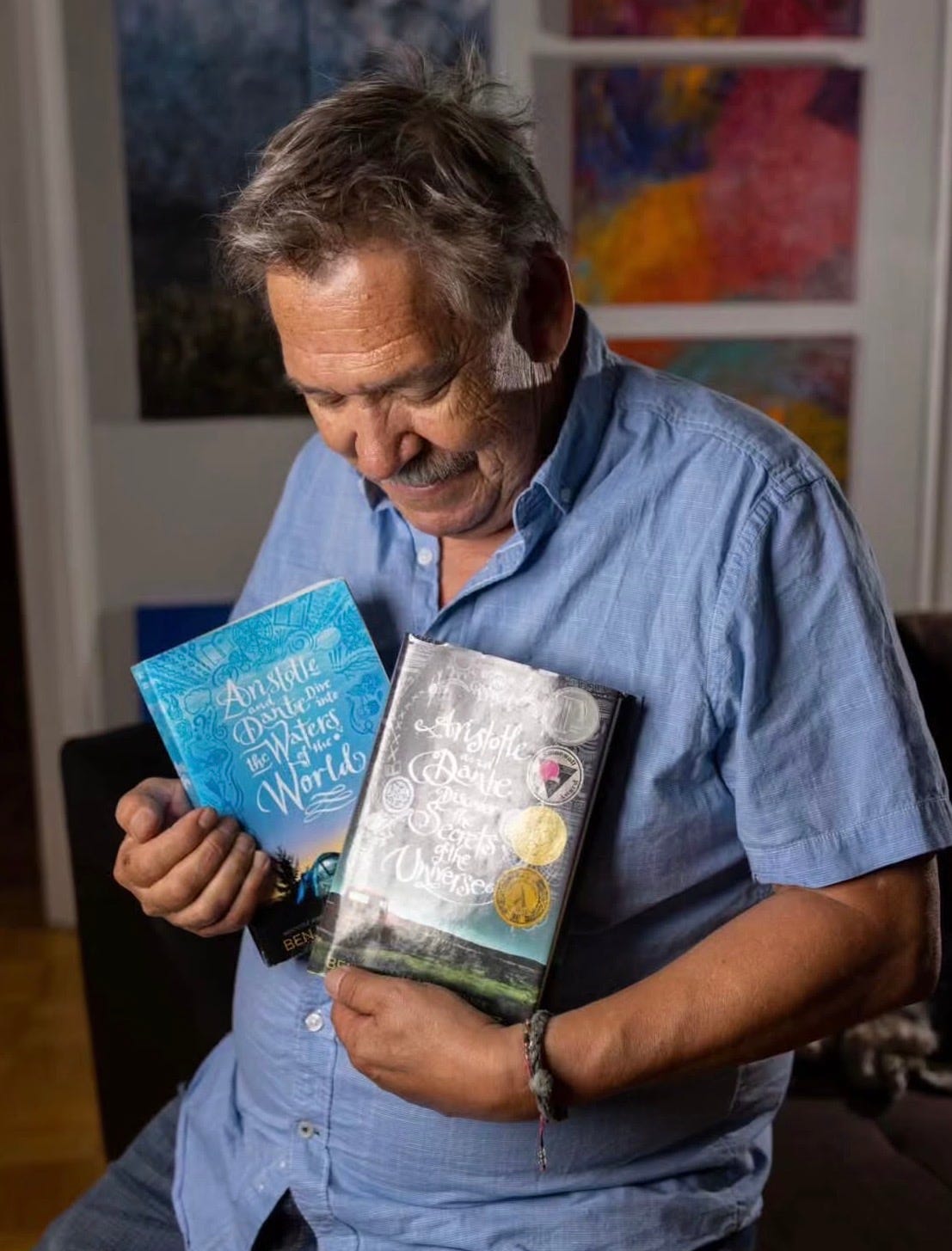
“The universe is vast, but love makes it intimate.”
It’s a baking hot day, like HOT - really hot, the sort of hot I always imagined Texas would be all year round, including Christmas Day. I’m walking to the corner shop for crisps and I’m supposed to be working on the cover of my own book - my OWN book - but am restless and distracted, because the first thing I learned on waking up was that Benjamin Alire Saenz had died.
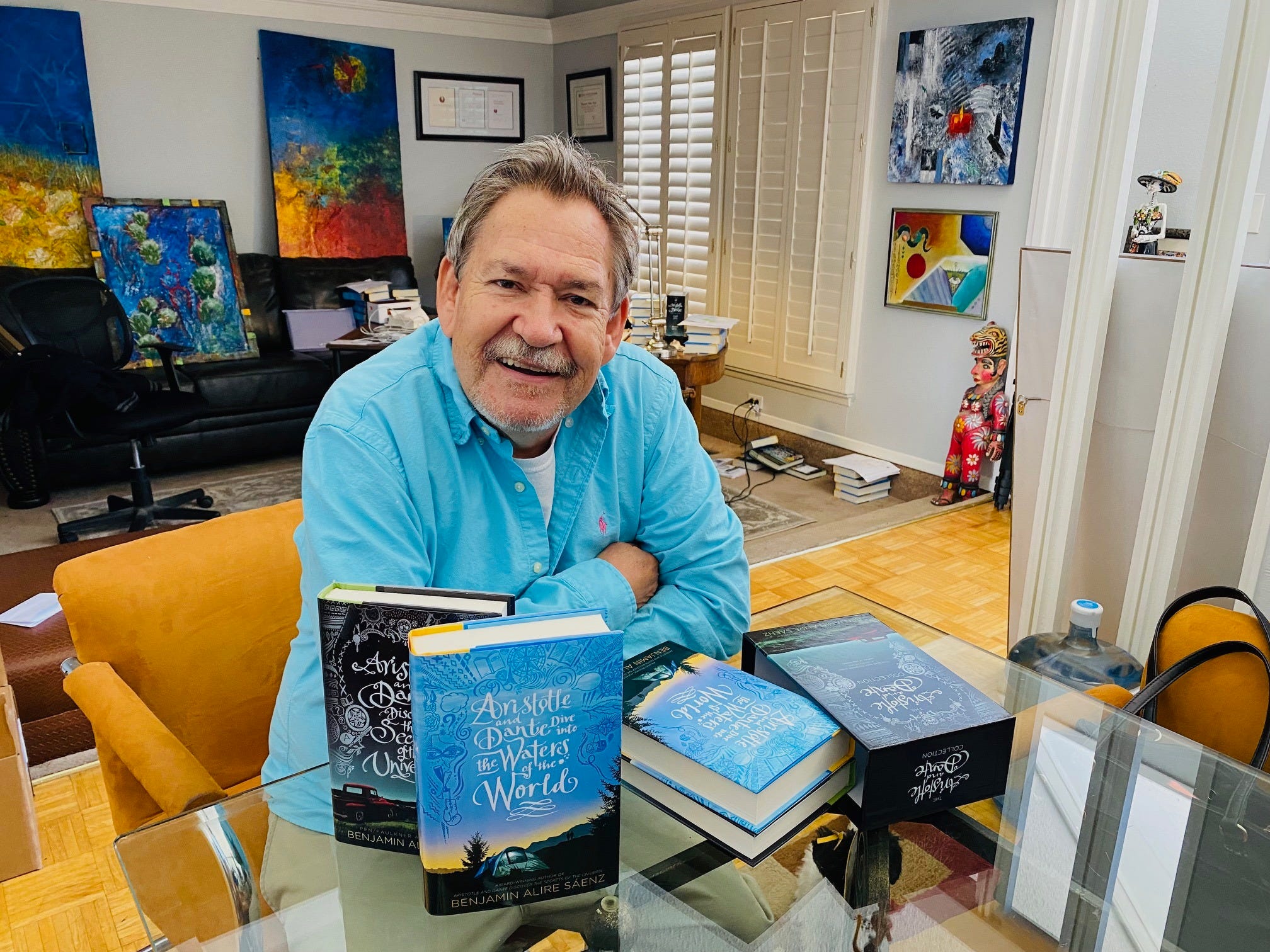
My own career as an author has begun in earnest, after a very long journey to publication, in the same week that dearly-loved Ben’s has ended. During his lifetime I was very, very privileged to have illustrated 4 of Ben’s book covers, but not just any four. Amazingly - and I often think that I can’t quite believe it myself - two are among the best-selling YA books of all time (incredibly, according to the statistics, ‘To Kill a Mockingbird’ still resides in those assorted lists, written in 1960, which I also did the cover for. You’ll find ‘Wolf Hollow’ by Lauren Wolk in many of those lists too, another book that wears my cover).
I don’t list these accomplishments to be show-off. Creating covers for books is a real honour, and a big responsibility. I know how long it has taken many of those authors to get that wedge of pages into publishable form, and then to get it INTO a publisher’s hands - then the selling of the book relies heavily on a good cover to get it into the READERS’ hands. The responsibility of a cover can feel like too much, sometimes, especially if the author is particularly famous, but always for a first-time author who has so much hoping and dreaming woven into those pages of the manuscript. There’s still a certain professional detachment and objectivity however that ensures protocols are followed, author’s wishes are not necessarily taken into account, and the best cover for the book is made, which may not be what they had ever actually had in mind; it has to be aesthetically-pleasing but its main purpose is, ultimately, to be one of the main tools that sell the book (which is perhaps why doing my own has unexpectedly thrown me into a temporary paralysis).
When I was invited to work on Ben’s book ‘Aristotle and Dante Discover the Secrets of the Universe’, it was to an extent, just another YA book. But then I read it. I always read the manuscript if it’s available, and had a feeling in my gut that this one was destined for something. But I was in one of the busiest periods of my life and just got straight to work, no time to fuss - at that time I would joke nervously about having become an illustration robot, which has a grim foreshadowing to it in the context of today’s AI nausea. I did the cover, did my best, and felt pleased. And though Ben was an established and respected author already, nobody knew how successful that book would become. From the day it was published, my name was irrevocably associated with the title, the adored main characters, and the lore, fandom and community that spring from it and his subsequent books, that thrives ever stronger today, and which I have loved being part of.
Although El Paso-based, Colorado-educated Ben would not necessarily have been a fan, he would undoubtedly have known of Colorado Poet Laureate Andrea Gibson, the first anniversary of whose death was a mere two weeks ago. My partner and I marked that privately and without fuss, as Andrea was an IRL friend as well as a colleague and a role model, who still feels very much in the room with us. In fact, Andrea feels MORE in the room with us now, despite living thousands of miles away in their time earthside and - well; now that they are not, having become part of everything. I think Ben felt the same to me. I never met him - I thought I would when I went to the Toronto premiere of the movie made from his novel - but his books were permanently on show in my office, fans would ask me to design tattoos of or inspired by Ben’s words (happy to oblige, always), order prints of Ari’n’Dante artwork and ask for specials. I’ve made Ben-inspired pieces available in my shop for at least the last ten years; fans like to order them for each other with hand-written messages. And news of his death came as I work on a new Ben project, which is, with beautiful timing, sitting on my desk, sheets of paper and ink work strewn a bit carelessly over my work surface. He was a constant, quiet presence in my life as an artist.
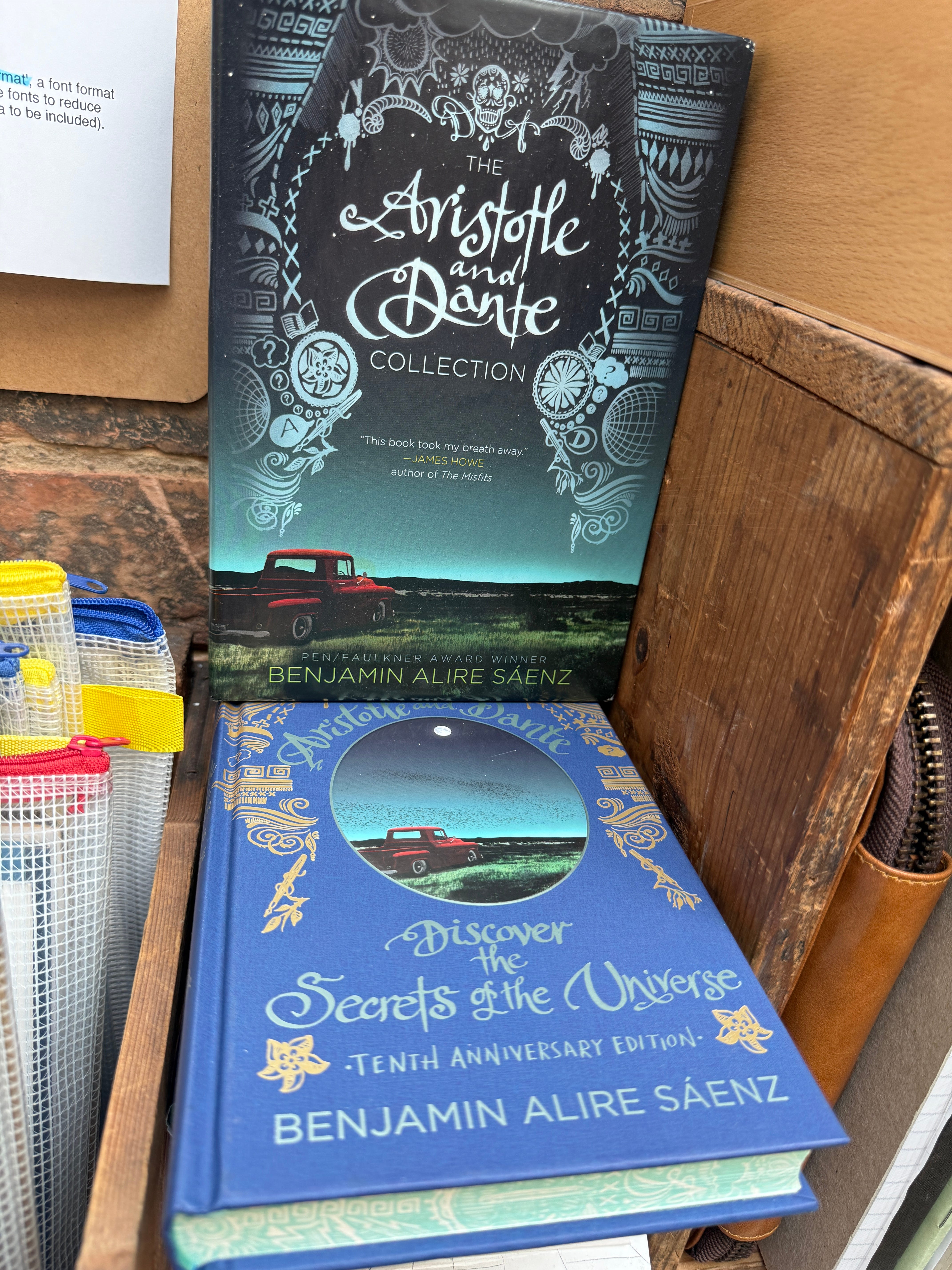
So I've decided to pitch Ben's passing to myself as a cosmic thing: I start my author journey for real at the same time Ben's finishes. That’s how I’m choosing to think about it anyway, not being a very cosmic person. I had to write about him first, I realised, because something had been getting in the way all morning, and it was Ben and the thoughts of all the very sad fans who will today be feeling the loss of both the man and any future stories he may have written.
I’m so very honoured to have been associated with this gentle, gifted man and his work. I hope his books carry on inspiring, soothing and engaging people, in particular the LGBTQ+ people he gave centre-stage to in his work, and for whom his books were, oftentimes literally as well as metaphorically, lifesavers.